Last verified on: September 21, 2025
Overview: What is the Programme, Who Runs It, Purpose
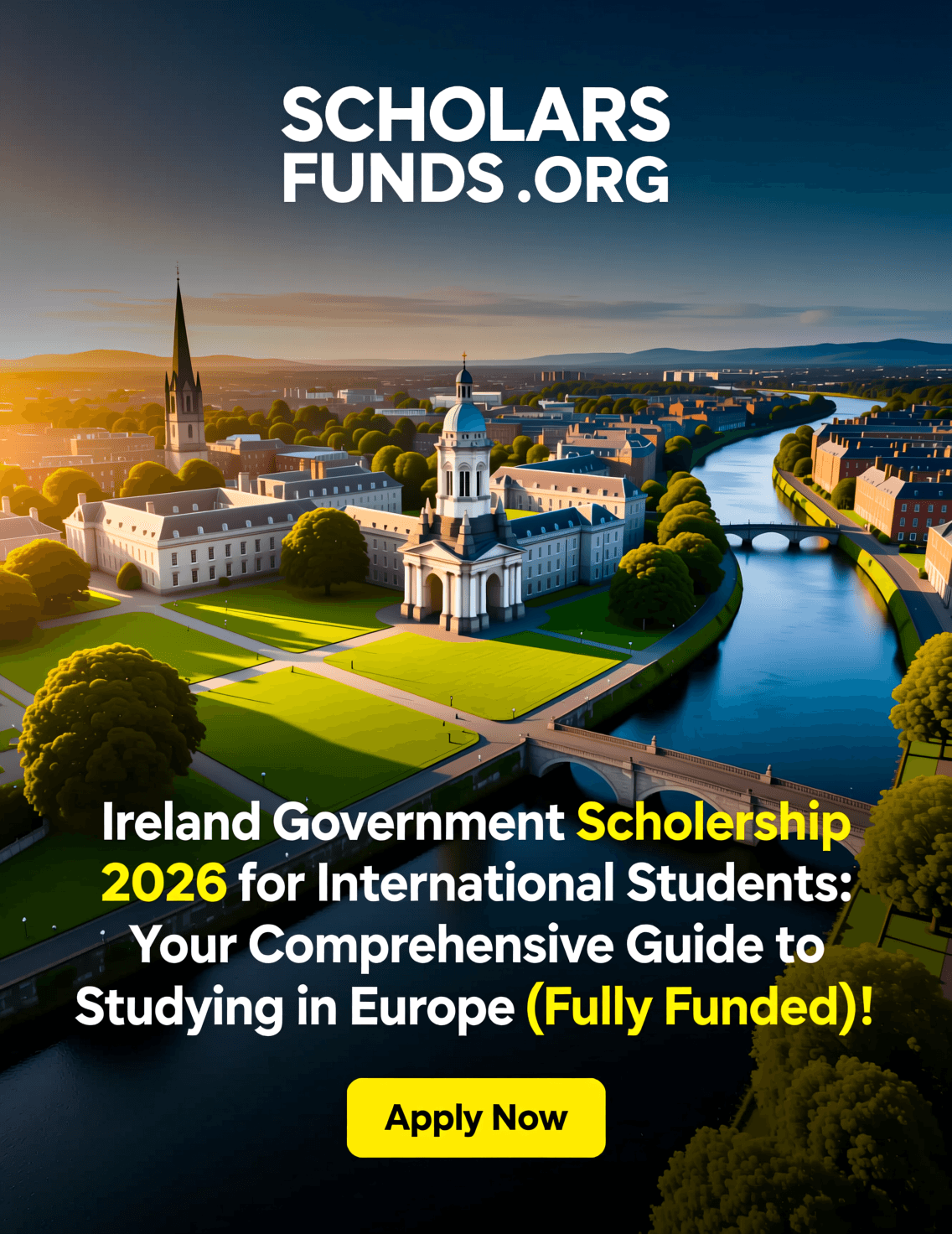
The Government of Ireland Postgraduate Scholarship Programme (GOIPG) is a national initiative to support full-time research postgraduate candidates (Master’s by research and doctoral/PhD) in any academic discipline. (Research Ireland)
It is funded by the Department of Further and Higher Education, Research, Innovation and Science, and managed by Research Ireland (Taighde Éireann), which was established in August 2024, combining the Irish Research Council (IRC) and Science Foundation Ireland (SFI). (Research Ireland)
Its purpose is to enable early-career researchers with high potential to conduct excellent research, to foster world-class potential, independence in research, and innovation, including interdisciplinary and emerging-field proposals. (Research Ireland)
Benefits / Funding: Amounts, Duration, What’s Covered
Annual funding can be up to €34,000 per year in any approved year under the 2026 call. (Research Ireland)
That consists of three parts:
Stipend: €25,000 per annum. (Research Ireland)
Fees contribution (including non-EU fees): up to €5,750 per annum. For non-EU nationals, there may be an additional €4,000 over-and-above the standard fee contribution in some cases. The remaining differential in fees is the responsibility of the recipient or the Research Body. (Research Ireland)
Direct research expenses: €3,250 per annum to cover project-related costs. (Research Ireland)
Duration: full-time funding ranges from 1 to 4 years, depending on degree type, status of registration, etc. New entrants can apply for full duration: 2 years for Master’s by research; 4 years for PhD. Applicants who have already started their degree but not beyond certain thresholds may be eligible for partial funding. (Research Ireland)
What is covered: stipend for living costs; fees (including non-EU fees up to ceiling) paid to host research institution; research project expenses.
What isn’t covered (or only partially): Any fees differential above the maximum fee contribution; anything beyond direct research expenses; part-time study (only full-time eligible); funding is not partial in that you cannot accept only part of the three budget headings. (Research Ireland)
Eligibility
Here are the core eligibility criteria for international and other applicants:
Criterion | Requirement |
Nationality / Residency | Open to applicants from any country. But two categories: Category 1: nationals of EU member states (and some other specified European states) and ordinary residence for 3 of the previous 5 years in those states. Category 2: all others. (Research Ireland) |
Academic level | Must be either (a) new entrant to a research Master’s by research or a doctoral/PhD degree, or (b) already registered but only in first year, under certain conditions. (Research Ireland) |
Previous registration | If first registration is before certain date (1 September 2025) then eligibility for full duration may be lost; partial duration applies if still within the allowed window. Also eligible career breaks may adjust these. (Research Ireland) |
Academic record | Applicants must have a first-class or upper second-class honours bachelor’s degree, or equivalent. If they do not, they must at least hold a Master’s degree. (Irish Research Council) |
Supervisor requirements | Must have a Primary Supervisor based at an eligible research-body in Ireland, who meets specified employment/qualification criteria. Primary supervisors may only support one applicant as primary supervisor. (Research Ireland) |
Other constraints | Applicants must not submit more than one application per call; there are limits on previous unsuccessful applications; and must comply with rules about overlapping funding (e.g., not holding other scholarships beyond certain thresholds). (Irish Research Council) |
If something can’t be verified (for example specific minimum grade in your country), refer to the official rules of equivalency.
Timeline & Deadlines
For the 2026 Call, the important dates are:
Call open: 12:00 (Irish time), 11 September 2025 (Research Ireland)
FAQ deadline: 16:00, 16 October 2025 (Research Ireland)
Applicant deadline: 16:00, 23 October 2025 (Research Ireland)
Supervisor / Mentor deadline: 16:00, 6 November 2025 (Research Ireland)
Research Office (institutional) endorsement deadline: 16:00, 13 November 2025 (Research Ireland)
Call outcome (results announced): End of April 2026 (Research Ireland)
Award start date: 1 September 2026 (Research Ireland)
Please note: deadlines refer to Irish local time; these are indicative, and applicants should verify each year’s specific publication.
How to Apply (Step-by-Step)
Check eligibility
Read the Call Document, the Terms & Conditions, and FAQ for the current year. (Research Ireland)
Complete the preliminary eligibility quiz on the GOIPG online system. Passing this quiz is required to get access to the full application form. (Research Ireland)
Identify a Primary Supervisor
Find a suitable Primary Supervisor at an eligible research institution in Ireland.
Ensure they meet eligibility (permanent or at least contracted staff, sufficient qualification, available resources, etc.). (Research Ireland)
Confirm supervisor agrees and understands their role.
Prepare the proposal and supporting materials
Write your research proposal, project plan, methodology, timeline.
Plan your training and career development pathway.
Secure references / referee reports.
Fill applicant forms via online portal
Use the SmartSimple platform (or whatever the current portal is). (Research Ireland)
Provide all required sections (research project, applicant CV, supervisor information).
Have supervisor/mentor complete their forms
Submit supervisor/mentor form by its deadline.
Institutional endorsement
Your higher education / research body must endorse the application via their Research Office by the endorsement deadline.
Submit before all deadlines
Make sure all parts (applicant form, supervisor / mentor form, referees (if required), institutional endorsement) are submitted before their respective deadlines. Late or incomplete applications are ineligible.
Required Documents: Checklist
Here are the documents / items you will need:
Completed eligibility quiz result (passes)
Research proposal (with methodology, timeline, significance)
Applicant’s CV / academic transcript(s) (Bachelor's, Master’s if applicable)
Degree certificate(s) or proof of pending graduation / expected results if not yet awarded (Irish Research Council)
Supervision plan; details about Primary Supervisor (including their CV or evidence of qualification)
Referee reports (if required) or mentor reports – depends on discipline / call rules (Irish Research Council)
Institutional endorsement letters from Research Office of the host HEI or Research Body
Training / career development plan
Ethics approval (if relevant for human/animal / sensitive research) or plan for obtaining ethics approval (Research Ireland)
Any documents for career break claims (if applying for adjustment), where relevant.
Selection Criteria & What Reviewers Look For
Applications are evaluated generally under four headings (weights may vary slightly depending on call / discipline, but these are typical):
Applicant (≈ 40%)
Academic record; previous achievements
Research potential; clarity of motivation
Fit between applicant and proposed project
Project quality (≈ 40%)
Originality, significance, innovation
Methodology, feasibility, clarity of plan, risk mitigation
Alignment with discipline(s) / wider strategic priorities, where applicable
Training & Career Development (≈ 10%)
Proposed training, skill acquisition, professional development
How the project will help the applicant’s career
Environment (≈ 10%)
Supervisory support, institutional resources, research environment
Access to facilities, infrastructure
Also reviewers look for: clear writing; a well-structured proposal; realistic timelines; budget justification; ethical considerations; and alignment with any strategic funding partner themes if applying under those.
Practical Tips to Strengthen an Application
Start early: Secure a supervisor early and begin drafting proposal ahead of time. Supervisor feedback is crucial.
Clarity in proposal: Your research question should be well defined. Methodology and feasibility should be believable.
Address interdisciplinary or emerging themes if relevant, since the programme encourages innovative and interdisciplinary proposals. (Research Ireland)
Tailor your training plan: Be specific in how you will develop skills (e.g. training courses, conferences, publications).
Budget and timeline realism: Be conservative where needed; show contingency and ethical planning.
Ensure eligibility quiz is passed; any discrepancy in supervisor name between eligibility stage and application can disqualify you. (Irish Research Council)
Proofread and remove identifying gender or personal identifiers where required (some applications need to be anonymised). (Dublin City University)
Check criteria for Category 1 vs Category 2 (nationality / residency), to know whether you are competing in the main pool or in the smaller international/residency category.
Official Links & Apply Now
Official programme page: Government of Ireland Postgraduate Scholarship Programme (GOIPG) page on Research Ireland – Research Ireland GOIPG (raw URL: https://research.ie/funding/goipg/) (Irish Research Council)
2026 Call Document (full rules, timelines, eligibility): GOIPG 2026 Call Document (raw URL: https://www.researchireland.ie/wp-content/uploads/2025/09/Government-of-Ireland-Postgraduate-Scholarship-2026_Call-Document.pdf) (Research Ireland)
Application portal: Applications are submitted through the SmartSimple platform via the Research Ireland website. To start, pass the eligibility quiz, then access the application through SmartSimple. (Research Ireland)
Indicative forms & guides:
Applicant Indicative Form for 2026 GOIPG (Research Ireland)
Primary Supervisor Form (indicated in downloadable documents on Research Ireland site) (Research Ireland)
Apply now: Visit the Research Ireland GOIPG page and follow links to the SmartSimple portal via “Apply” (raw: https://research.ie/funding/goipg/) then log in / register.
FAQ (Common Questions)
Q1: Can I apply if I’m non-EU / international student?
A: Yes. The programme is open to applicants from any country. You will fall under Category 2 if you do not meet Category 1’s nationality/residency criteria. However, the number of awards to Category 2 applicants is smaller compared to Category 1. (Research Ireland)
Q2: What if I have already started my Master’s or PhD?
A: You may still be eligible if you have not completed more than the first year, under certain conditions. There are cut-off registration dates; older registrations may disqualify full-duration funding, but partial funding may apply. Career breaks may adjust eligibility. (Research Ireland)
Q3: Can I combine this scholarship with other funding?
A: Possibly, but there are limits. Scholars cannot hold other bursaries/scholarships whose combined value (stipend, fees, expenses) exceed certain amounts. Also, some scholarships may conflict in terms of overlapping responsibilities. Always disclose all other funding. (Irish Research Council)
Q4: What is the success rate?
A: Approximately 18% over the past five years. This is for the postgraduate scholarship programme, across disciplines. (Irish Research Council)
Q5: Is there a minimum grade requirement from my bachelor’s degree?
A: Yes — a first-class or upper second-class honours bachelor’s (or equivalent) is required. If not, then holding a Master’s degree may satisfy the academic criterion. Equivalent grading depends on your country / institution. (Irish Research Council)
Call to Action
If you are interested in pursuing advanced research in Ireland, check the full 2026 GOIPG Call Document now and prepare your application via the SmartSimple application portal using official guidance and forms. Visit Research Ireland’s GOIPG page to begin.
Disclaimer: While this article is based on the latest available official sources as of September 21, 2025, programme rules, deadlines, and amounts may change. Always refer to the current call document on the Research Ireland website for final details.