Author: Hammad Ishaq
Last verified on: September 28, 2025
Overview
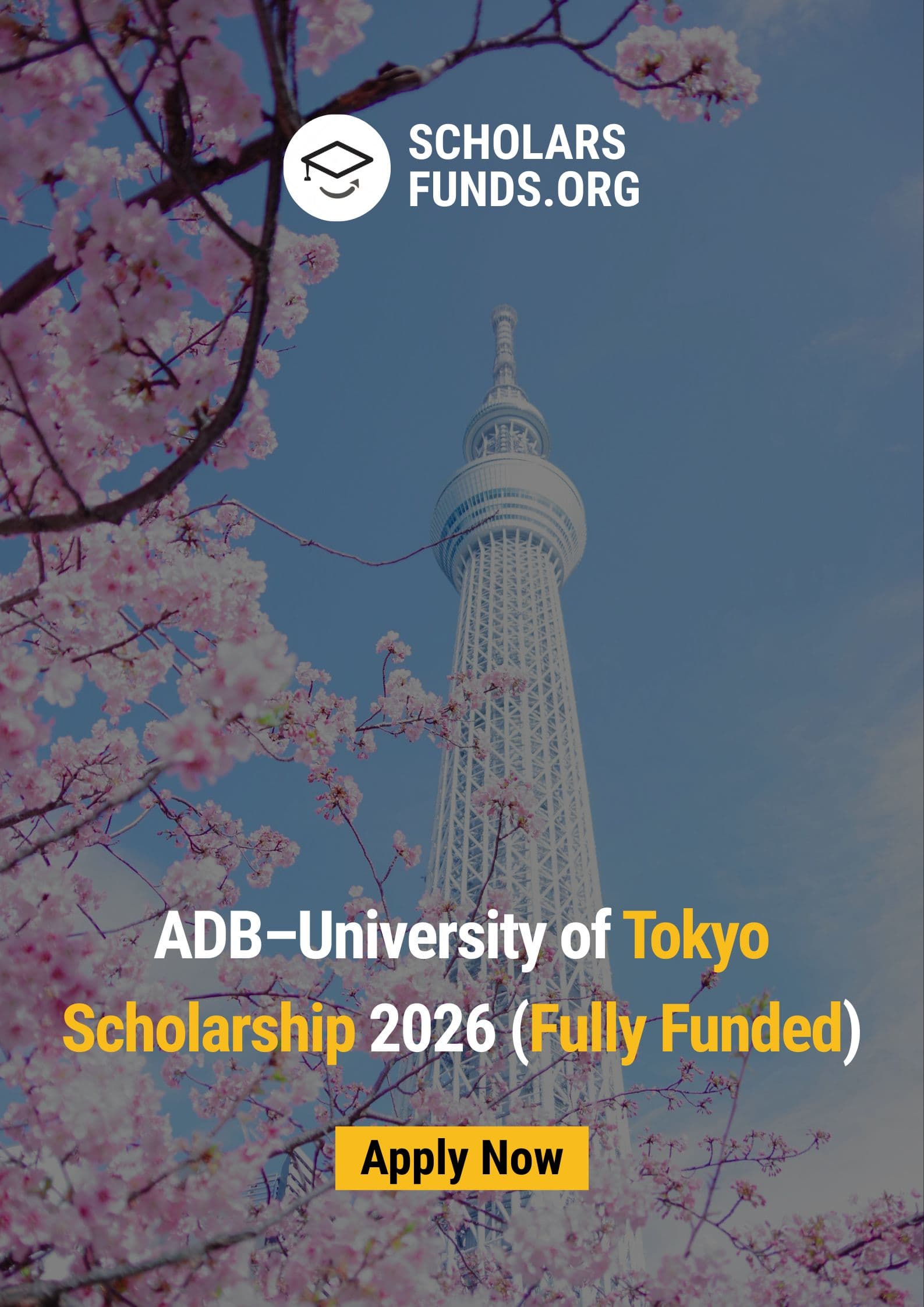
The ADB–Japan Scholarship Program (ADB-JSP) is a collaboration between the Asian Development Bank (ADB) and host institutions in Japan to support students from ADB’s developing member countries in pursuing master’s level study in development-related fields. The University of Tokyo is one of the designated Japanese institutions participating in ADB-JSP. (Asian Development Bank)
The purpose is to build human resources in sectors critical to socio-economic development in Asia and the Pacific, such as environmental studies, sustainability, public policy, engineering, and international studies. Scholars are expected to return to their home countries and contribute to development after graduation. (Asian Development Bank)
Benefits / Funding
From official sources and University of Tokyo information, the benefits include the following:
Full tuition fee waiver at the host institution. (k.u-tokyo.ac.jp)
Monthly subsistence allowance, including housing. (k.u-tokyo.ac.jp)
Allowance for books and instructional materials. (k.u-tokyo.ac.jp)
Comprehensive medical and accident insurance. (Asian Development Bank)
Airfare for travel to/from Japan (economy class), visa fees, entrance fees, etc., for admitted scholars. (k.u-tokyo.ac.jp)
Duration: The scholarship covers up to two years (master’s course), provided academic performance is satisfactory. (k.u-tokyo.ac.jp)
What’s not clearly specified: As of last verification, the official sources do not explicitly list amounts for subsistence/housing allowance (in JPY or other currency) for University of Tokyo under ADB-JSP for the 2026 intake. (k.u-tokyo.ac.jp)
Eligibility
Here are the eligibility criteria applicants must meet, based on official sources:
Citizenship: Must be nationals of an ADB borrowing member country. (Asian Development Bank)
Academic level: Applicants must have a Bachelor’s degree (or its equivalent) and be applying to a master’s level programme. PhD/dotoral applicants are not eligible under ADB-JSP. (k.u-tokyo.ac.jp)
Professional experience: At least two years of full-time, professional work experience after completion of the undergraduate degree is required. Internships or student assistant roles during undergraduate studies generally do not count. (Asian Development Bank)
Age limit: Candidates must not be over 35 years old at the time of application. Some exceptions might be possible for senior officials/managers in certain programmes, but UTokyo’s ADB-JSP explicitly disallows candidates over 35. (k.u-tokyo.ac.jp)
Fields of study: Permitted fields at University of Tokyo include Environmental Studies, Sustainability Science, International Studies, Human and Engineered Environmental Studies, Natural Environmental Studies, Ocean Technology, Policy & Environmental Studies, Socio-cultural Environmental Studies, Environment Systems, etc. (k.u-tokyo.ac.jp)
Other requirements: Applicants must be in good health; agree to return and work in home country after study. Also, only those admitted through designated programmes at the University of Tokyo can be nominated. (Asian Development Bank)
Timeline & Deadlines
Here are the important timeline items for ADB-JSP at University of Tokyo for Fall/October 2026 entry:
Stage | Approximate Period / Date |
Application opens for Fall/October 2026 | Around June 2025 (University of Tokyo announcement period) (k.u-tokyo.ac.jp) |
Submission deadline (University-side for master’s admission / ADB-JSP application) | December 10, 2025 for many departments at University of Tokyo. (k.u-tokyo.ac.jp) |
University internal screening / document verification | After deadline; often December through February. (k.u-tokyo.ac.jp) |
Nomination to ADB | Around mid-February to March 2026 (for those who pass University screening) (k.u-tokyo.ac.jp) |
Selection result notification | May 2026 for ADB-JSP at University of Tokyo. (k.u-tokyo.ac.jp) |
Enrollment / Program start | Late September to early October 2026. (k.u-tokyo.ac.jp) |
Applicants must check specific department deadlines (some differ). Also confirm in 2025 announcements, since UTokyo posts guidelines for each department. (k.u-tokyo.ac.jp)
How to Apply (Step-by-Step)
Here are the steps to apply:
Check eligibility
Confirm you are from an ADB borrowing member country, have requisite degree, work experience, and that your field of study is offered under ADB-JSP at UTokyo. Use the official ADB-JSP FAQ and UTokyo’s Graduate School of Frontier Sciences (GSFS) pages. (k.u-tokyo.ac.jp)Choose department and research supervisor
Look up allowed master’s programmes under ADB-JSP at UTokyo (e.g. Environmental Studies, Sustainability Science, etc.). Identify potential faculty members willing to supervise your research. (k.u-tokyo.ac.jp)Prepare application materials
Gather required documents: transcripts, diploma, proof of work experience, research proposal, etc. See checklist below. Also prepare English proficiency test scores if required. (sih.m.u-tokyo.ac.jp)Submit master’s admission application via UTokyo portal
Apply to the University of Tokyo’s Graduate School of Frontier Sciences (GSFS), or specific department through their online application system, by the deadline (typically December 10 for many departments). This is often the “ordinary examination” process. (k.u-tokyo.ac.jp)Application to ADB-JSP via UTokyo nomination
After your admission application, if selected internally, the University will nominate eligible candidates to ADB-JSP. Only nominated candidates need to submit additional scholarship forms required by ADB. (k.u-tokyo.ac.jp)Wait for selections
ADB makes final selection and notifies both University and applicant around May. If successful, proceed with visa, travel, and enrollment processes. (k.u-tokyo.ac.jp)
Required Documents Checklist
Based on UTokyo and ADB official information, applicants generally must provide:
Completed application form for the University of Tokyo master’s programme. (sih.m.u-tokyo.ac.jp)
Research plan / study field & research proposal. (k.u-tokyo.ac.jp)
Official academic transcript(s) (undergraduate, and master if applicable). (sih.m.u-tokyo.ac.jp)
Degree certificate or proof of graduation. (sih.m.u-tokyo.ac.jp)
Evidence of two years of full-time professional work experience after undergraduate degree. (Asian Development Bank)
English language test score (TOEFL/IELTS etc.), unless exempted under UTokyo rules. (sih.m.u-tokyo.ac.jp)
Two letters of recommendation. (sih.m.u-tokyo.ac.jp)
Passport copy / identification. (Standard). As of last verification, passport requirement is implied but not always explicitly listed in all departmental guidelines. (sih.m.u-tokyo.ac.jp)
Any required departmental forms (e.g. inquiry sheet, supervisor list). (sih.m.u-tokyo.ac.jp)
Selection Criteria & What Reviewers Look For
Some of the main criteria used to select the successful candidates include:
Academic performance: Undergraduate grades (and master, if applicable). High GPA or equivalent is favorable.
Relevance & quality of research proposal: Clarity of research plan, how it ties to development challenges and your past academic/professional background.
Work experience: Quality and relevance of your professional work (must be full-time, post-degree). It demonstrates maturity, capacity to contribute.
Field relevance: Priority is often given to applicants whose topics are aligned with development-related areas (environment, sustainability, public policy, etc.).
Potential to contribute to home country: Scholars must demonstrate intent to return and apply their skills in their home country; commitment to development.
Communication skills: Clarity in writing, proficiency in English, quality of recommendation letters.
Age eligibility and completeness: Meeting all formal requirements (age, citizenship, required documents) is necessary. If any required document is missing, application may be rejected.
Practical Tips to Strengthen Your Application
Start early: identifying supervisors, preparing proposal, and securing recommendation letters takes time.
Tailor your research proposal to address real challenges in your country or the region; show you understand both theory and practice.
Highlight how your work experience has prepared you: mention responsibilities, outcomes, leadership or teamwork.
Obtain strong recommendation letters: from professors or employers who know you well and can speak to academic potential and professional maturity.
Be very clear about your plan after returning home: maybe in a short-essay or in your proposal, show realistic application of your studies.
If English test scores are required, aim higher than minimum cutoffs; also check for exemptions and whether your prior studies qualify.
Double-check your documents for formatting, translation if required, and correctness (dates, titles, etc.).
Read carefully the department’s particular instructions (they may vary with regard to forms, submission, thesis supervisor etc.).
Official Links & Apply Now
Below are authoritative official resources:
ADB’s JSP Home Page (“What We Do: Japan Scholarship Program”) – for general program rules, list of participating institutions, FAQs.
ADB-JSP official program page (https://www.adb.org/what-we-do/funds/japan-scholarship-program-jsp) (Asian Development Bank)University of Tokyo – ADB-JSP Master’s Foreign Research Students Page (Graduate School of Frontier Sciences) – detailed guidelines for applicants to UTokyo.
UTokyo GSFS ADB-JSP page (https://www.k.u-tokyo.ac.jp/en/exam/master/foreign_research_students/adb_jsp/) (k.u-tokyo.ac.jp)Application Guide / Documents Page (for 2026 or most recent entrance exam) – includes checklist, application forms, etc.
UTokyo ADB-JSP Application Guide and Checklist (https://www.sih.m.u-tokyo.ac.jp/admission-en/) (sih.m.u-tokyo.ac.jp)
Apply Now: Use the UTokyo GSFS page above to access the application portal. Ensure you follow that department’s instructions.
FAQ
Q1: Can I apply for a PhD under ADB-JSP at the University of Tokyo?
A1: No. The ADB-Japan Scholarship Program covers master’s level study only. PhD applicants are not eligible under ADB-JSP. (k.u-tokyo.ac.jp)
Q2: Can I be over 35 years old and still be eligible?
A2: As per the UTokyo ADB-JSP guidelines, applicants aged over 35 years are not eligible. Exceptional age relaxations are not clearly provided for UTokyo in the current guidelines. (k.u-tokyo.ac.jp)
Q3: Do I need to know Japanese language?
A3: No. Most courses under ADB-JSP at UTokyo are conducted in English, and UTokyo does not require Japanese proficiency for the departments under ADB-JSP. (k.u-tokyo.ac.jp)
Q4: Can I apply if I have less than two years of full-time work experience?
A4: No. The official requirement is at least two years of full-time, professional work experience after university graduation. Internships, part-time work, or work done during undergraduate study generally do not qualify. (Asian Development Bank)
Q5: Is it possible to combine ADB-JSP with other scholarships?
A5: It depends. You must check both the policies of UTokyo and ADB. Some scholarship regulations do not permit overlapping funding for the same items (tuition, travel, stipends). If you get another scholarship, make sure it does not conflict or that you obtain permission. Official pages do not specify in all cases whether dual awards are allowed. As of last check, the UTokyo ADB-JSP page does not state explicitly whether combining with other scholarships is allowed. (k.u-tokyo.ac.jp)
Conclusion & Call-To-Action
If you meet the eligibility criteria, are ready with required work experience, and have a strong research plan, this is a valuable opportunity to pursue a master’s degree in Japan with full financial support.
👉 Apply now via the University of Tokyo ADB-JSP portal: UTokyo GSFS ADB-JSP application page (https://www.k.u-tokyo.ac.jp/en/exam/master/foreign_research_students/adb_jsp/)
Make sure you review the application guide (see admission-en page) and departmental deadlines. Best of luck with your application!
Disclaimer: While this information was verified as of September 28, 2025, details (such as deadlines, exact stipend amounts, eligibility) may change. Always refer to the official UTokyo and ADB-JSP pages linked above for the most up-to-date instructions and figures.