Author: Hammad Ishaq
Last verified on: September 30, 2025
1. Overview: What the program is, who runs it, purpose
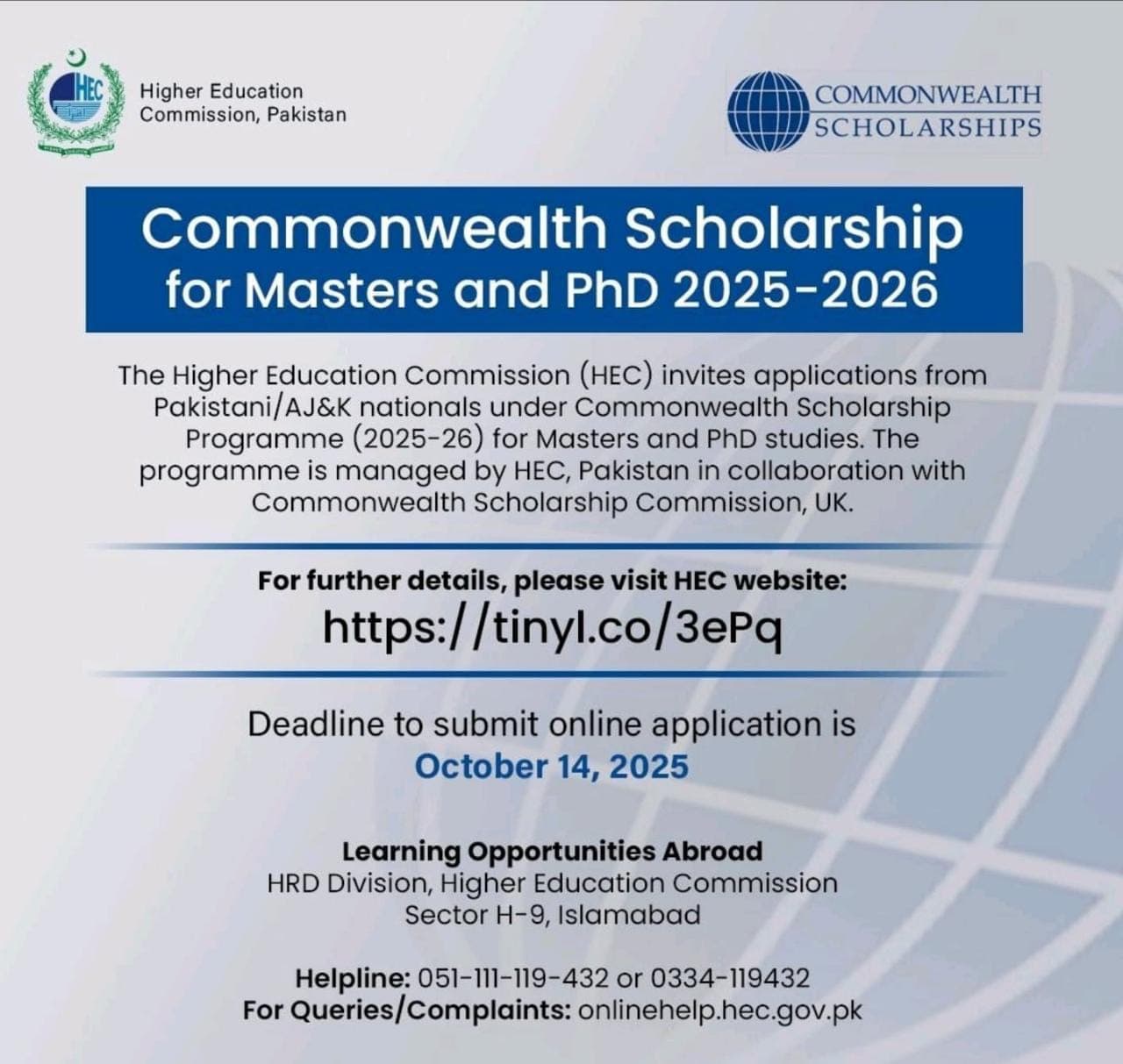
The Commonwealth Scholarships for Masters & PhD via HEC (often called “HEC-Commonwealth Scholarships”) is a scheme where the Higher Education Commission (HEC) of Pakistan acts as the national nominating agency for Commonwealth Scholarships offered by the UK’s Commonwealth Scholarship Commission (CSC). (CSCUK)
HEC’s role is to facilitate, screen, and endorse Pakistani applicants against national criteria, then submit nominations to CSC in the UK. The CSC is the ultimate funder and decision-maker. (Higher Education Commission)
The purpose is to build research capacity and help talented Pakistani students contribute to development goals by studying in world-class UK institutions under the Commonwealth Scholarship & Fellowship Plan (CSFP). (CSCUK)
2. Benefits / Funding: amounts, duration, what’s covered (and not covered)
Because this is a CSC scholarship (via HEC nomination), benefits follow CSC’s standard coverage for UK-based awards. (CSCUK)
Typical coverage includes:
Full tuition fees (payable to the UK university) (CSCUK)
Economy (approved) airfare to and from your home country to the UK (one round trip) (CSCUK)
Monthly living stipend / maintenance allowance (to cover accommodation, food, general living) (CSCUK)
Visa cost reimbursement (or visa support) in many cases (CSCUK)
Study-related travel grants (within UK or fieldwork travel) in some cases (CSCUK)
Warm clothing allowance (if needed, based on climate) (CSCUK)
Additional allowances for dependents in some cases (child allowance) (CSCUK)
Tenure / Duration:
For a Master’s scholarship, duration is usually one year (full-time taught) (CSCUK)
For a full PhD scholarship (for least developed / developing countries), typical tenure is up to three years (CSCUK)
(Note: there is also a “Split-site PhD” pathway, but HEC’s scheme mostly aligns with full CSC PhD awards) (CSCUK)
Important caveats / what’s not always covered:
Costs not approved under CSC rules (e.g. expensive travel deviations) may not be reimbursed (CSCUK)
Some allowances (e.g. for dependents) are discretionary and subject to rules (CSCUK)
The scholarship does not support multiple concurrent awards covering the same costs. Holding another full scholarship covering fees + stipend may disqualify you. (CSCUK)
After the scholarship ends, CSC generally requires scholars to return to their home countries and does not support remaining under the UK’s Graduate visa route (except in specific cases) (CSCUK)
As of last verification, the HEC/CSC pages do not publish a fixed rupee amount for stipend for Pakistani awardees—stipends are paid in GBP per CSC regulations. (CSCUK)
3. Eligibility
You must satisfy both HEC national criteria and CSC UK criteria. Failing either may disqualify your application.
HEC Pakistan eligibility (national level)
As per HEC’s official eligibility page: (Higher Education Commission)
Must be a Pakistani / AJ&K national and permanent resident in Pakistan / AJ&K. Dual nationals are not allowed. (Higher Education Commission)
For a Master’s scholarship: you must have a first division (or equivalent) in a 16-year Bachelor’s / Master’s degree in a relevant field. (Higher Education Commission)
For a PhD scholarship: you must hold a first division in a 17- or 18-year Master’s / MS / MPhil degree in the relevant discipline. (Higher Education Commission)
You must not have second or third division in your terminal (most recent) degree. If results are still pending, you may still apply. (Higher Education Commission)
All applicants must take the HAT (Higher Education Aptitude Test) and secure at least 60 out of 100 in general category test. (Higher Education Commission)
Only HAT taken on or after October 16, 2022 is valid (older scores without specifying region/title might be accepted with conditions) (Higher Education Commission)
The merit ranking will be based strictly on HAT scores (open merit) unless HEC revises criteria. (Higher Education Commission)
HEC may require English proficiency (IELTS / TOEFL or certificate) under its general eligibility rules (some pages mention this) (Higher Education Commission)
(As of last verification) HEC’s eligibility page does not impose age limits. As some external sources claim age caps (e.g. 30 for Master, 35 for PhD), but these are not in HEC’s official eligibility. (Higher Education Commission)
CSC / UK side eligibility (in addition)
You must also satisfy CSC’s general conditions for Commonwealth Scholarships: (CSCUK)
Citizenship (or refugee / British Protected Person status) from an eligible Commonwealth country. In this case, your Pakistani citizenship qualifies you. (Study UK)
Permanent residence in that same country (Pakistan) (Study UK)
You must be available to begin studies in the UK by the start of the UK academic year (September/October) in the year you apply for. (Study UK)
If applying for a Master’s scholarship, CSC generally does not fund a second UK Master’s degree—applicants must justify a second Master's if applying. (CSCUK)
You must show financial need, i.e. you would not be able to study in the UK without the scholarship. (CSCUK)
You must submit full academic transcripts, detailed references (usually two or more) and, for PhD applicants, a supporting statement from a proposed UK supervisor. (CSCUK)
For PhD applicants: you must not already be registered for a PhD (or an MPhil leading to PhD) at a UK or home institution before the scholarship start date. (Higher Education Commission)
If any of these conditions are not met, your application could be rejected either by HEC or by CSC.
4. Timeline & Deadlines
Below is the typical timeline and deadlines based on current announcements. Always verify the year-specific deadline.
Stage | Approximate Date / Period | Notes |
CSC / Commonwealth portal opens | Around 2 September of application year (Higher Education Commission) | For example, in HEC’s procedure it states the CSC portal goes live on 2 September. (Higher Education Commission) |
Submission deadline (HEC & CSC) | October 14, 2025 at 4:00 PM (Pakistan Standard Time) (SAMAA TV) | HEC has officially stated this as the close of its portal. (SAMAA TV) |
Nomination by HEC to CSC | Shortly after deadline | HEC screens and endorses candidates, then forwards to CSC. (Higher Education Commission) |
CSC decision / results | Several months later (often mid-year) | Historically, results may be announced ~ by mid-year to allow visa and enrolment. (CSC’s timelines vary) |
Award start date in UK | September / October of the academic year | Candidates must begin studies by then. (Study UK) |
Note: In past cycles, HEC’s portal deadlines (like October 15, 2024) have been used. (Higher Education Commission) Always cross-check for the specific year you are applying.
5. How to Apply (Step-by-Step)
You must submit applications on both the Commonwealth (CSC) portal and the HEC portal. Failure to submit on either will invalidate your application. (Higher Education Commission)
Step 1: Apply via Commonwealth / CSC portal (EAS system)
Wait until the CSC Electronic Application System (EAS) opens (around 2 September) (Higher Education Commission)
Select the relevant scholarship program (Master’s or PhD) in your country of application. (CSCUK)
Fill in personal, academic, and employment history.
Upload required documents (transcripts, degree certificates, references, research proposal for PhD, etc).
For PhD, provide supporting statement from prospective UK supervisor(s).
Submit before the CSC deadline.
Download/print your submitted application and reference number.
Step 2: Apply via HEC Pakistan portal
Go to HEC’s scholarship portal: scholarships.hec.gov.pk (Higher Education Commission)
Register (or log in) and update your profile (email, contact, etc). (Higher Education Commission)
Under “Scholarship & Grants”, choose “Learning Opportunities Abroad (LOA)” and then select the Commonwealth Scholarship program. (Higher Education Commission)
Fill the application form, ensuring it mirrors essential information submitted in CSC application.
Enter your HAT test score (must be at least 60) in the HEC form. (Higher Education Commission)
Upload required supporting documents (see next section).
Submit before HEC’s deadline and obtain a printed hard copy of your HEC application for your records and (if required) signature.
Make sure you have archived copies of both your HEC and CSC applications.
Important: HEC clearly warns that applications missing either the CSC or HEC submission will not be considered. (Higher Education Commission)
6. Required Documents Checklist
Below is a checklist of documents you commonly need (both CSC and HEC). Always see the year-specific checklist.
Valid citizenship proof (NIC / passport)
Recent passport-size photograph
Academic transcripts for all degrees
Degree certificates / provisional certificate
Equivalence certificate (if needed, especially for foreign degrees)
Statement of Purpose (motivation)
Research proposal (for PhD)
Supporting statement from UK supervisor (for PhD)
Two or more reference letters (on official letterhead or from institutional emails)
HAT test result (minimum 60/100)
English proficiency evidence (IELTS/TOEFL or certificate, if required)
Domicile / proof of residence
Copy of CNIC / identity documents
Any additional awards, publications, extracurriculars
Keep clear scanned PDFs. Ensure file sizes and formats are as per instructions.
7. Selection Criteria & What Reviewers Look For
The selection process proceeds in stages: HEC screening and then CSC final selection. Below are the principal criteria:
HAT test score is central to the HEC screening (minimum 60/100). (Higher Education Commission)
Academic excellence / first division in your previous degrees (no low grades or second/third divisions).
Relevance and quality of proposal / research plan, especially for PhD candidates.
Strength of references – depth, direct knowledge of you, comments on aptitude, originality, impact.
Alignment with development impact — CSC emphasizes that your proposed study should contribute to development goals in Pakistan. (CSCUK)
Justification of financial need – convincing rationale that you cannot fund the UK study yourself.
For PhD: fit with supervisor and host institution in UK, viability of research design.
Diversity / equitable representation: HEC commits to gender balance (minimum 45% female representation in nominations) (Higher Education Commission)
Unblemished record, honesty; false information leads to cancellation / disqualification. (Higher Education Commission)
In CSC’s evaluation, similar criteria apply: academic merit, potential, development impact, references, quality of proposal, and compliance with rules. (CSCUK)
8. Practical Tips to Strengthen Your Application
Prepare early – secure and polish your research proposal, obtain supervisor contacts, make connections early.
Take HAT early and aim high – since HAT score is crucial in HEC screening, invest in preparation.
Select UK supervisors strategically – choose those who have worked in your field, reference their publications, demonstrate interest (contact them politely).
Write a compelling development narrative – frame how your work links to national / global challenges and future impact.
Secure strong referees – pick referees who know your work well, provide guidance or bullet points to them.
Carefully sync both applications – inconsistencies between HEC and CSC forms can cause rejection.
Follow guidelines strictly – formatting, file sizes, deadlines.
Backup and track everything – save submission receipts, screenshots, email confirmations.
Review sample successful applications / reports (if available)
Address weaknesses – if your score or previous record is slightly weak in one area, compensate with strength in other areas (e.g., outstanding proposal or strong publications).
9. Official Links & Apply Now
HEC Commonwealth Scholarships main page (overview) – HEC “CWGS” site (Commonwealth Scholarships) (https://www.hec.gov.pk/site/cwgs) (Higher Education Commission)
HEC Application Procedure page – how to apply steps (https://www.hec.gov.pk/english/scholarshipsgrants/lao/cwgs/Pages/Application-Procedure.aspx) (Higher Education Commission)
HEC Eligibility Criteria page (national criteria) (https://www.hec.gov.pk/english/scholarshipsgrants/lao/cwgs/Pages/Eligibility-Criteria.aspx) (Higher Education Commission)
CSC Commonwealth Master’s Scholarships (CSC UK site) – details and criteria (https://cscuk.fcdo.gov.uk/scholarships/commonwealth-masters-scholarships/) (CSCUK)
CSC FAQs / What the scholarship covers (https://cscuk.fcdo.gov.uk/commonwealth-scholarships-frequently-asked-questions/) (CSCUK)
HEC Online Scholarship Portal (apply here) – scholarships.hec.gov.pk (raw) (Higher Education Commission)
Call to Action: Begin your application today — open the HEC scholarship portal (https://scholarships.hec.gov.pk/) and the CSC EAS portal (via CSC’s website) and submit both before the deadline.
10. FAQ
Q1: Can I apply if I already have a Master’s degree?
Yes, for a PhD scholarship, having a Master’s is required. But for a Master’s scholarship, applying for a second UK Master’s is generally discouraged; you must justify it. (CSCUK)
Q2: Can dual nationals apply?
No, HEC disqualifies dual nationals for this scheme. (Higher Education Commission)
Q3: Can I apply to other scholarships simultaneously?
You may apply to others, but you should not hold overlapping awards covering the same costs. Also, CSC rules disallow holding concurrent awards that cover fees / maintenance for the same period. (CSCUK)
Q4: If I miss HAT, can I still apply later?
No. The HAT result (≥60) is mandatory and must be uploaded with your application. (Higher Education Commission)
Q5: What if my CSC application is stronger but HEC rejects it?
HEC’s screening is crucial — if you fail national criteria or miss HAT, your file won’t move forward. Ensure full compliance with both sides.
Disclaimer: Always double-check the official pages (HEC and CSC) for the most up-to-date deadlines, eligibility changes, and procedural tweaks, especially in future years.