Overview: What Is the Romania Government Scholarship?
The Romanian Government runs this scholarship under Government Decision No. 288/1993 and administers it jointly through the Ministry of Foreign Affairs (MFA) and the Ministry of Education and Research (MER). Every year, the program awards fully funded places at accredited public universities across Romania — in cities like Bucharest, Cluj-Napoca, Iași, and Timișoara — to citizens from non-EU countries.
The goal is to promote Romanian language, culture, and academic ties with partner nations across Asia, Africa, the Middle East, and Latin America. Roughly 85 funded seats go out each cycle to applicants from more than 120 countries. No IELTS. No TOEFL. No age limit.
What sets this apart from a lot of European scholarships is the centralized application model. You submit one file through the Study in Romania portal and indicate your preferred field and university. The ministries handle placement. You do not chase individual professors or survive multiple rounds of institutional applications.
Benefits and Funding Coverage
Here is the honest breakdown of what the scholarship covers and what it does not. I find the accommodation subsidy is the most underrated benefit — university dormitory rooms in Romanian cities run between €60 and €85 per month, which is low even by Eastern European standards.
Benefit | Coverage Status | Amount or Notes |
|---|---|---|
Tuition fees | Fully covered | All public universities, full program duration |
Romanian language preparatory year | Fully covered | Mandatory if you do not already hold B1 Romanian |
Monthly stipend (Bachelor / Prep year) | Provided | ~€65/month equivalent in Romanian lei |
Monthly stipend (Master's) | Provided | ~€75/month equivalent |
Monthly stipend (PhD) | Provided | ~€85/month equivalent; paid full calendar year |
Dormitory accommodation | Subsidized | Subject to available places at host university |
Application/registration fees | Waived | No fees charged for online application |
Emergency health coverage | Included | Endemic/epidemic illnesses covered |
Local transport concessions | Included | Buses, trains, metro, river transport |
International airfare | NOT covered | Student bears full travel cost |
Border-to-university transport | NOT covered | Student responsibility |
Food and personal expenses | NOT covered | Budget ~€600/month total per official guidance |
I would flag the airfare gap to every applicant I talk to — it catches people off guard after selection. Plan for it early.

Eligibility Requirements
The scholarship is open wide in terms of geography but has real academic conditions. The minimum academic average of 7/10 (equivalent to "Good") trips up applicants who do not check it against their home-country grading system in advance — that is the most common eligibility mistake I see.
Requirement | Bachelor's Track | Master's Track | PhD Track |
|---|---|---|---|
Citizenship | Non-EU country | Non-EU country | Non-EU country |
Prior education | High school + baccalaureate diploma | Bachelor's degree | Master's degree or equivalent |
Minimum academic average | 7/10 ("Good") in last completed school | 7/10 in undergraduate studies | Strong academic record |
Age limit | None | None | None |
IELTS / TOEFL | Not required | Not required | Not required (PhD may study in English with supervisor agreement) |
Language of study | Romanian (prep year offered) | Romanian (prep year offered) | Romanian or foreign language per doctoral school |
PhD supervisor agreement | N/A | N/A | Mandatory before applying |
Fields excluded | Medicine, Dentistry, Pharmacy | Medicine, Dentistry, Pharmacy | Medicine, Dentistry, Pharmacy |
The PhD supervisor agreement is non-negotiable. Without a written confirmation from a thesis supervisor who is a member of the target doctoral school, your application file is ruled incomplete — not just weak.
Who cannot apply: Citizens of EU countries; people of Romanian origin or from Romanian historical communities (separate programs exist for them); diplomatic corps members and their families; anyone already on a Romanian state scholarship for the same study cycle.
Timeline and Deadlines
The 2026–2027 cycle deadline was March 31, 2026, with results announced around July 15, 2026. The 2027–2028 cycle (Romania scholarships 2027) typically follows the same annual calendar. Watch the official Study in Romania portal from January 2027 for the exact opening date.
Stage | Approximate Date | Action Required |
|---|---|---|
Application portal opens | Mid-February 2027 | Create account on Study in Romania platform |
Application deadline | End of March 2027 | Submit complete file — no extensions granted |
Selection results announced | Around July 15, 2027 | Check email from MFA |
Accept/decline scholarship | Within window post-results | Respond via platform |
Request long-stay study visa | After acceptance | Contact nearest Romanian embassy |
Preparatory year begins | September/October 2027 | Enroll at assigned university |
Degree program begins | September/October 2028 | After passing B1 Romanian assessment |
How to Apply — Step by Step
Go to the official portal. Open https://scholarships.studyinromania.gov.ro and create your account. The platform runs in English and French, so no Romanian knowledge is needed to apply.
Complete every section of the online form. Fill in personal information, academic history, country of origin, and your preferred field of study. Be precise — post-submission changes are not accepted.
Select your study level and field. Choose Bachelor's, Master's, or PhD. Avoid Medicine, Dentistry, and Pharmacy — the scholarship does not cover these at any level.
For PhD applicants specifically: Contact the doctoral school at your target university before you apply and get a written agreement from your intended thesis supervisor. Upload this with your application. This step alone costs applicants their spot when they skip it.
Upload all required documents (see the checklist section below). Scan each document individually as a color PDF. Do not compress multiple documents into one file.
Sign the GDPR data processing declaration inside the platform. Without this, the system will not validate your registration.
Submit before the deadline. The system closes at the deadline — there are no extensions. I always recommend submitting at least a week early so you can fix any upload errors flagged by the portal.
If you are comparing this application against others, our complete list of fully funded Master's scholarships breaks down similar no-IELTS opportunities across Europe that you can pursue in parallel.
Required Documents Checklist
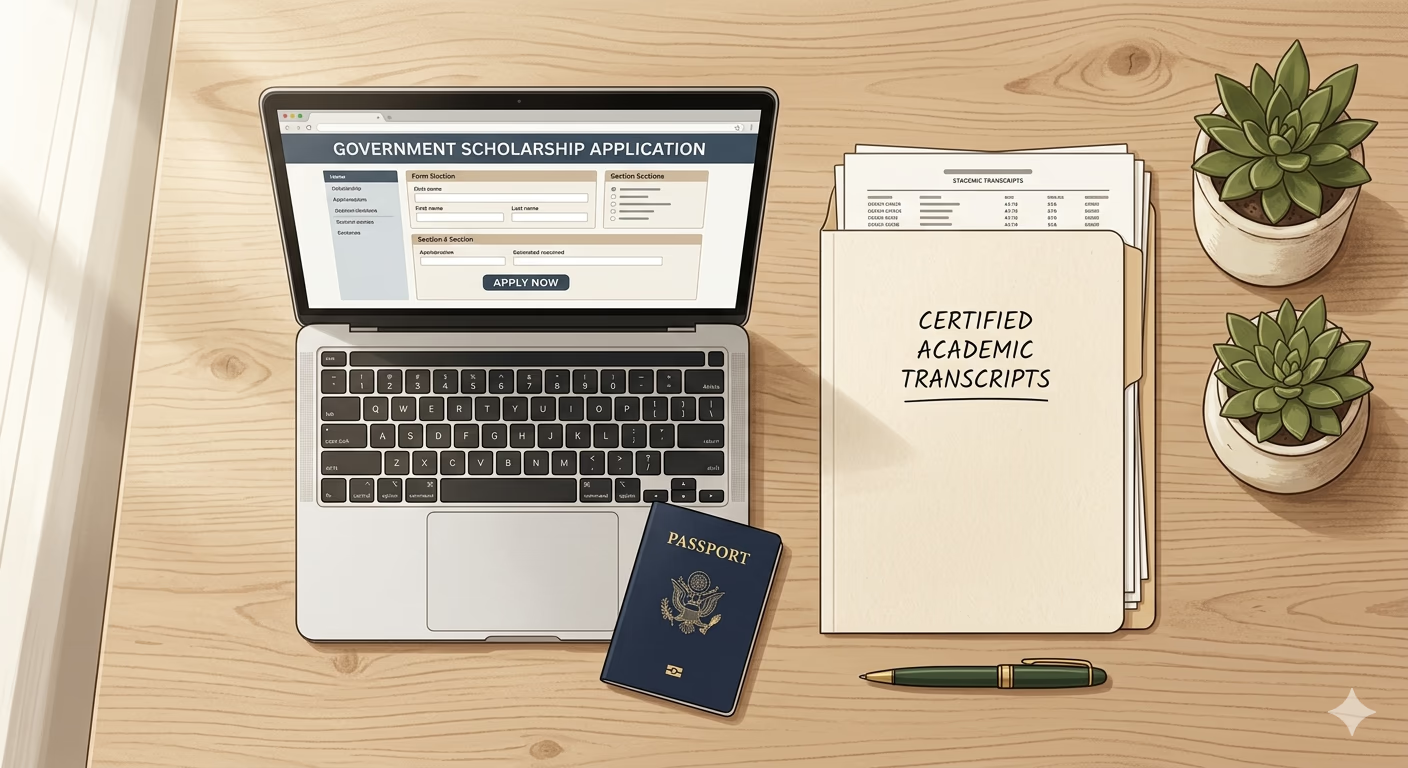
Gather and apostille every document before the portal opens — do not wait until the last week.
Diplomas and degree certificates — copies of baccalaureate, bachelor's, master's, or doctorate (whichever applies), with authorized translation into English, French, Spanish, or Romanian
Academic transcripts — for all completed study years, with authorized translation
Birth certificate — copy plus authorized translation
Valid passport — copy of first three pages (passport must be valid; expired passports cause instant rejection)
Curriculum Vitae — in English, French, or Romanian (no specific template required by the MFA)
For PhD only: Letter of intent detailing your proposed research project, list of publications, and the written agreement of your doctoral supervisor — all in English, French, or Romanian
Proof of name change — if your current name differs from what appears on academic documents
Certificate of completion of Romanian language preparatory year — only if you previously completed one
Parental consent declaration — notarized, if you are under 18 at the time courses start
All study documents must carry an apostille under the Hague Convention or authentication from your country's Ministry of Education. This is the document most applicants get wrong. A regular notarized copy is not enough — the apostille must be present.
Germany also offers a route into free European education. If you want a comparison, our guide on how to apply to German universities in 2026 for free walks through the full process.
Selection Criteria
The MFA and MER evaluate applications based on a competition of files — meaning no interview for most levels (the exception is PhD, where an admission interview at the doctoral school is required before you even submit your file to the portal).
Selection reviewers primarily assess:
Academic average: The 7/10 minimum is a floor, not a target. Competitive applicants typically sit well above this.
Completeness of file: Missing documents disqualify applications outright, regardless of academic strength.
PhD research alignment: For doctoral applicants, the research proposal and supervisor match carry the most weight.
Available seats: Final placement depends on seats available at the preferred institution. The MER reserves the right to assign an alternative university in the same field if your first choice is full.
What separates shortlisted applications from rejected ones, in my reading of the official guidelines, is almost never the personal statement — it is document accuracy. The applicants who get cut are the ones with missing apostilles, expired passports, or unsigned GDPR declarations.

Practical Tips to Strengthen Your Application
Start with the apostille, not the application form. Getting documents apostilled through your country's Ministry of Education takes 3–8 weeks in many South Asian countries. Start this process in November or December, before the portal even opens. I have seen otherwise strong files rejected for a missing apostille that the applicant thought was optional.
For PhD applicants, treat the supervisor contact like a job application. Write a concise, specific research proposal email — three paragraphs maximum. Name the doctoral school, explain why your background fits their lab's current work, and attach your CV. Most supervisors at Romanian universities respond within two weeks if your email is targeted.
Use the preparatory year as a real strategic advantage. A lot of applicants see the Romanian language requirement as an obstacle. It is not. The preparatory year is fully funded, gives you 12 months to settle in, build local friendships, and understand how Romanian universities operate before your degree program starts. Students who arrive with this foundation perform measurably better.
If you are looking for income while navigating your studies, check our list of AI websites paying $30–$60 per hour for remote work in 2026 — several of these are open to international students and can help offset the living costs the scholarship does not cover.
Official Links and Apply Now
Apply only through the official channel. Any third-party "application service" charging fees for this program is a scam — the Romanian government charges nothing to apply.
Study in Romania Scholarship Portal (application and account creation): https://scholarships.studyinromania.gov.ro
Program information and official eligibility rules: Visit the Official Programme Information Page (https://scholarships.studyinromania.gov.ro/scholarship-about)
General study in Romania guide: Visit the Study in Romania national portal (https://studyinromania.gov.ro)
The window for the 2026–2027 cycle has closed. Set a reminder for January 2027 and monitor the portal for the 2027–2028 intake opening date. When it opens, go in immediately — the 31-day window moves fast.
FAQ
Can I study in English on the Romania government scholarship?
Bachelor's and Master's programs under this scholarship run entirely in Romanian. The government offers a fully funded one-year preparatory course to help you reach B1 level before your degree begins. PhD students can study in English or another language if the doctoral school approves it and the thesis supervisor agrees in writing.
Is there an age limit for the Romania scholarships 2027?
There is no age limit. The official portal confirms this clearly. Any source claiming a specific age cap is citing outdated or unofficial information.
Do I need IELTS or TOEFL to apply for Romania scholarships without IELTS?
No IELTS or TOEFL score is required. Bachelor's and Master's programs are in Romanian, so English proficiency tests are irrelevant to the core application. At PhD level, if you pursue an English-language doctoral program, your supervisor and doctoral school set any language conditions — not the MFA portal.
How many scholarships does Romania award each year?
Roughly 85 fully funded places go out per annual cycle, drawn from applicants in over 120 countries. The competition is genuine, and the file-completeness bar is strict — many applicants are cut before academic merit is even reviewed.
What happens if my preferred university has no available seats?
The Ministry of Education and Research assigns you an alternative institution in the same field of study if your first-choice university cannot accommodate you. You cannot request a change of field or university after placement. Review the field options carefully before submitting — this decision is final.
Disclaimer: All dates, funding amounts, eligibility rules, and document requirements listed in this article are drawn from the official Study in Romania portal and the MFA scholarship guidelines as verified on April 21, 2026. Details for the 2027–2028 cycle have not yet been officially published. Verify every requirement directly at https://scholarships.studyinromania.gov.ro before applying, as conditions may change between cycles.