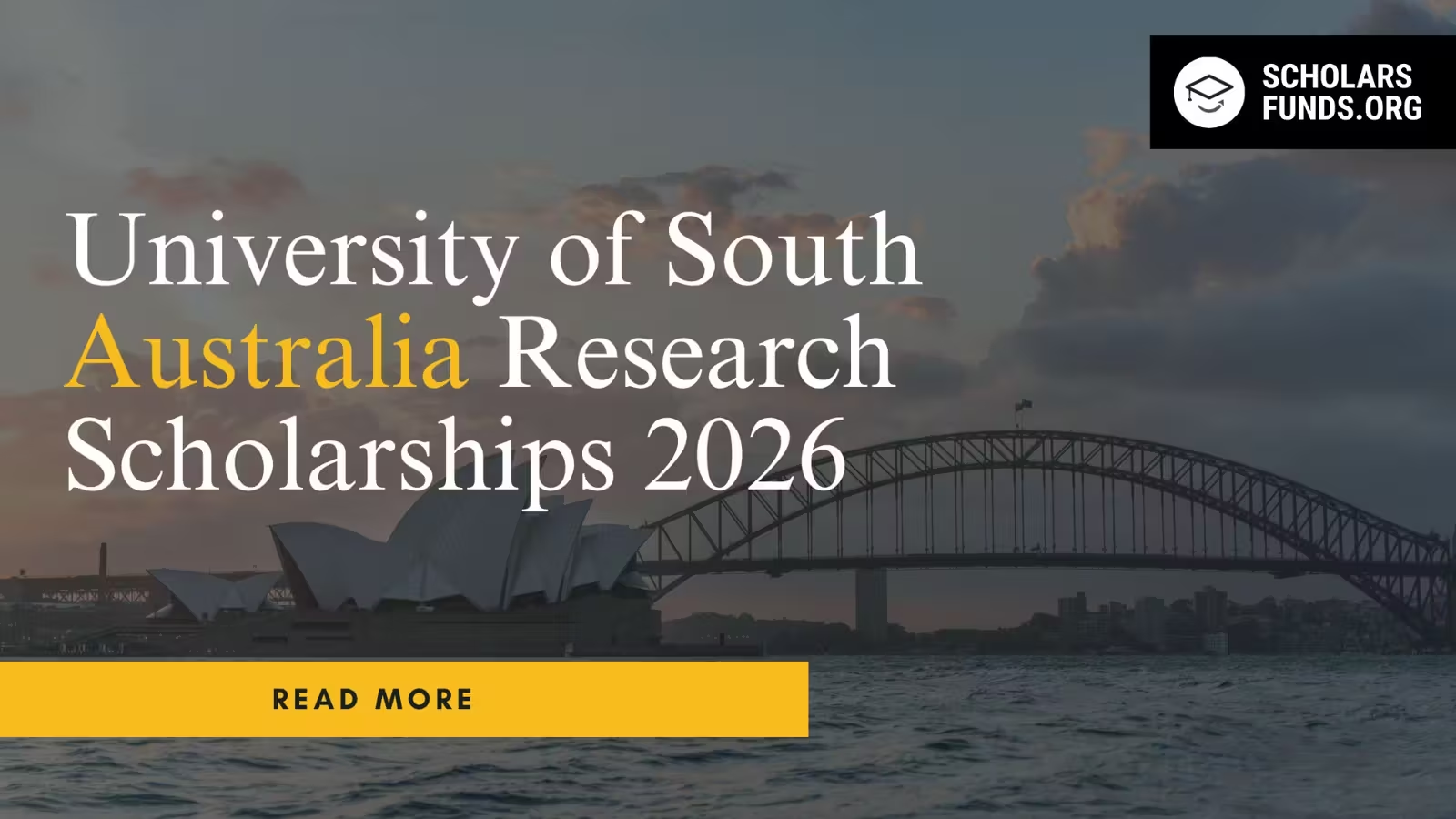
Before you spend a single hour polishing your research proposal, there is something almost every blog about the University of South Australia research scholarships 2026 gets completely wrong and it could send you in the wrong direction from the start.
UniSA no longer exists as a standalone university.
As of January 2026, the University of South Australia merged with the University of Adelaide to form a brand-new institution: Adelaide University. The old UniSA website now redirects you there. So if you have been reading articles that say "apply at unisa.edu.au," those articles are already out of date. The scholarships themselves continue — the funding, the stipends, the tuition waivers — but the name, the portal, and the structure have changed. Your first stop for a 2026 application is adelaideuni.edu.au, not the UniSA site.
Now that that is out of the way, let me walk you through what this scholarship actually is, what it covers, and what a competitive application looks like.
What These Research Scholarships Actually Are
Under the old UniSA framework — which Adelaide University has carried forward — there were three distinct research scholarship types for international students. Understanding the difference between them matters, because they do not all give you the same things.
Research Training Program International (RTPi) Scholarships are funded by the Australian Government and awarded on academic merit and research potential. This is the flagship option. It includes a living stipend and a full tuition fee waiver.
Enterprise Research Scholarships (ERS) are funded by the university and/or industry partners. They carry the same stipend and fee waiver structure as the RTPi but are typically tied to specific research projects with an industry or external partner on the supervisory panel.
International Research Tuition Scholarships (IRTS) cover tuition fees only. There is no living stipend attached. The IRTS is designed for students who already hold an external scholarship or government sponsorship that covers their living costs — think HEC Pakistan awardees or students sponsored by their home institution. If that is you, IRTS can cover what your sponsor does not.
The IRTS also does not include Overseas Student Health Cover (OSHC), so you would need to arrange that separately as a visa requirement.
What the Scholarship Covers — and What It Does Not
For RTPi and ERS recipients, the package is genuinely comprehensive:
Benefit | RTPi / ERS | IRTS |
|---|---|---|
Living stipend | AUD $35,200/year (2025 rate), paid fortnightly | ✗ Not included |
Tuition fee waiver | Up to 4 years (PhD) / 2 years (MRes) | Up to 4 years (PhD) / 2 years (MRes) |
Health cover (OSHC) | Included — singles cover via BUPA | ✗ Not included |
Thesis allowance | Included | Not confirmed |
A few things the official page does not clarify and that most scholarship blogs gloss over: the stipend is for the student only. If you bring a spouse or children to Australia, their health insurance is not covered. You will need to budget separately for dependants. The stipend is also tax-exempt for full-time candidates, which makes it stretch further than it might look on paper — but it is a living allowance, not a salary. Adelaide is not the cheapest city in Australia, but it is significantly more affordable than Sydney or Melbourne.
As of last check, the official page does not confirm a specific total number of scholarships awarded per intake cycle.
The Application Process — and the Part Most Students Get Backwards
Here is where applicants consistently make the most costly mistake: they try to apply for the scholarship and then find a supervisor. The process actually works in reverse.
You must find and secure a supervisor first.
Applications are submitted through specific research projects that already have a scholarship attached. You cannot walk in with a general application and ask for funding. You browse available projects on the Adelaide University research portal, identify one that aligns with your interests and background, contact the supervisor to express your interest, and then apply through that project's dedicated link.
This matters for South Asian applicants especially, because the competition for supervisors in engineering, computer science, and health sciences is intense. A cold email that says "I want to do a PhD with you" goes nowhere. An email that says "I have read your 2024 paper on X, I have relevant experience in Y from my thesis work, and I would like to discuss whether you are taking candidates for the Z project" actually gets replies.
One more timing note: Adelaide University has confirmed no additional international scholarship round is scheduled for the first half of 2026. Applications are being accepted on an out-of-round, project-by-project basis. That means you are not waiting for a single annual deadline — but you are also not guaranteed a slot will be available in your area when you are ready to apply. Checking the project listings regularly is the practical approach here.
What a Strong Application Looks Like
The selection criteria are academic merit and research potential. In practice, that means two things carry the most weight: your grades and your evidence of being able to do independent research.
For the grades requirement, you generally need first-class Honours or an equivalent GPA. For Pakistani students, this typically means a CGPA of 3.5 or higher on a 4.0 scale, though there is no stated cutoff. For a PhD, a completed master's degree is expected.
For research potential, publication experience helps — but it is not mandatory. What matters more is that you can describe your prior research clearly and connect it to the specific project you are applying for. A good research statement does not just summarise your thesis; it explains what question you were trying to answer, what method you used, and what you found. Then it explains why that makes you the right person for this project, not just for "a PhD in general."
English proficiency requirements apply. IELTS Academic of 6.5 overall (no band below 6.0) is the standard entry point, though specific supervisors or programs may require higher.
What to Do Right Now
If you are serious about a University of South Australia research scholarship for 2026 — now housed under Adelaide University — here is the sequence that actually works:
Go to the new portal: Visit adelaideuni.edu.au and navigate to Graduate Research scholarships. Ignore outdated blog posts linking to the old UniSA site.
Browse funded projects: Use the "Find a research project" page to filter by your discipline. Look specifically for projects that have a scholarship attached — not all listed projects include funding.
Email supervisors before you apply. Introduce yourself specifically: your background, a paper of theirs you have read, why their project interests you. Keep it to three short paragraphs.
Prepare your documents in parallel: Academic transcripts, English test scores, a draft research statement, and two academic referees who know your research work.
Apply through the project link once a supervisor confirms interest.
The transition from UniSA to Adelaide University has created real confusion in the scholarship space — almost every guide out there is still writing about a university that merged over four months ago. That confusion is, strangely, an advantage for students who do their homework. You will walk into the supervisor email and the application portal with more clarity than most of your competitors.
For more guidance on writing a strong research statement or scholarship SOP, ScholarsFunds.org has resources specifically for international students navigating competitive research applications.